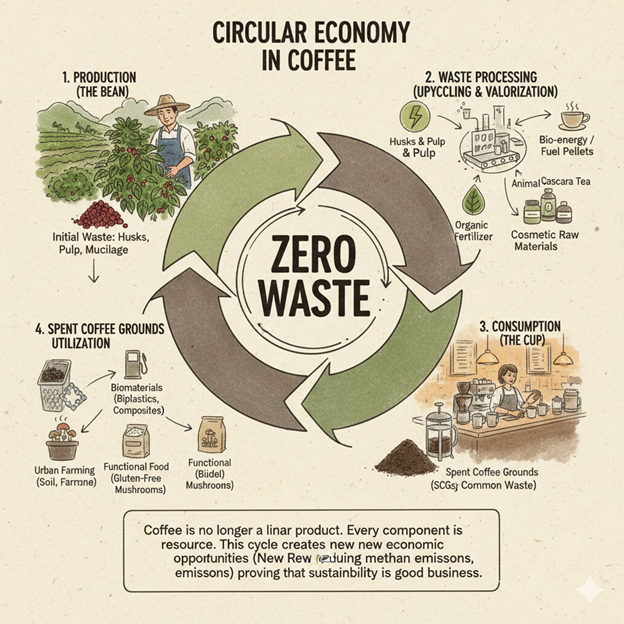
The concept of a circular economy in coffee promotes a zero-waste approach, where every component of the coffee value chain is transformed into valuable resources. This system turns coffee from a linear product into a regenerative and sustainable resource — creating economic, social, and environmental benefits across its life cycle. By reducing methane emissions, minimizing waste, and driving innovation, the coffee circular economy proves that sustainability is both responsible and profitable.
Coffee cultivation generates by-products such as husks, pulp, and mucilage. Once considered waste, these materials are now recognized as valuable bioresources — reused for fertilizers, biomass energy, and organic composting.
Instead of discarding husks and pulp, they are transformed into bioenergy, fuel pellets, organic fertilizers, and cascara tea for livestock. These efforts reduce environmental impact while creating new income streams for local farmers.
At the consumer stage, spent coffee grounds (SCGs) become the main waste product. Through collection and repurposing, SCGs gain a new life in multiple industries, extending coffee’s impact beyond consumption.